Leander Kills in the StudioInterview with Valentin Jankai
No. 1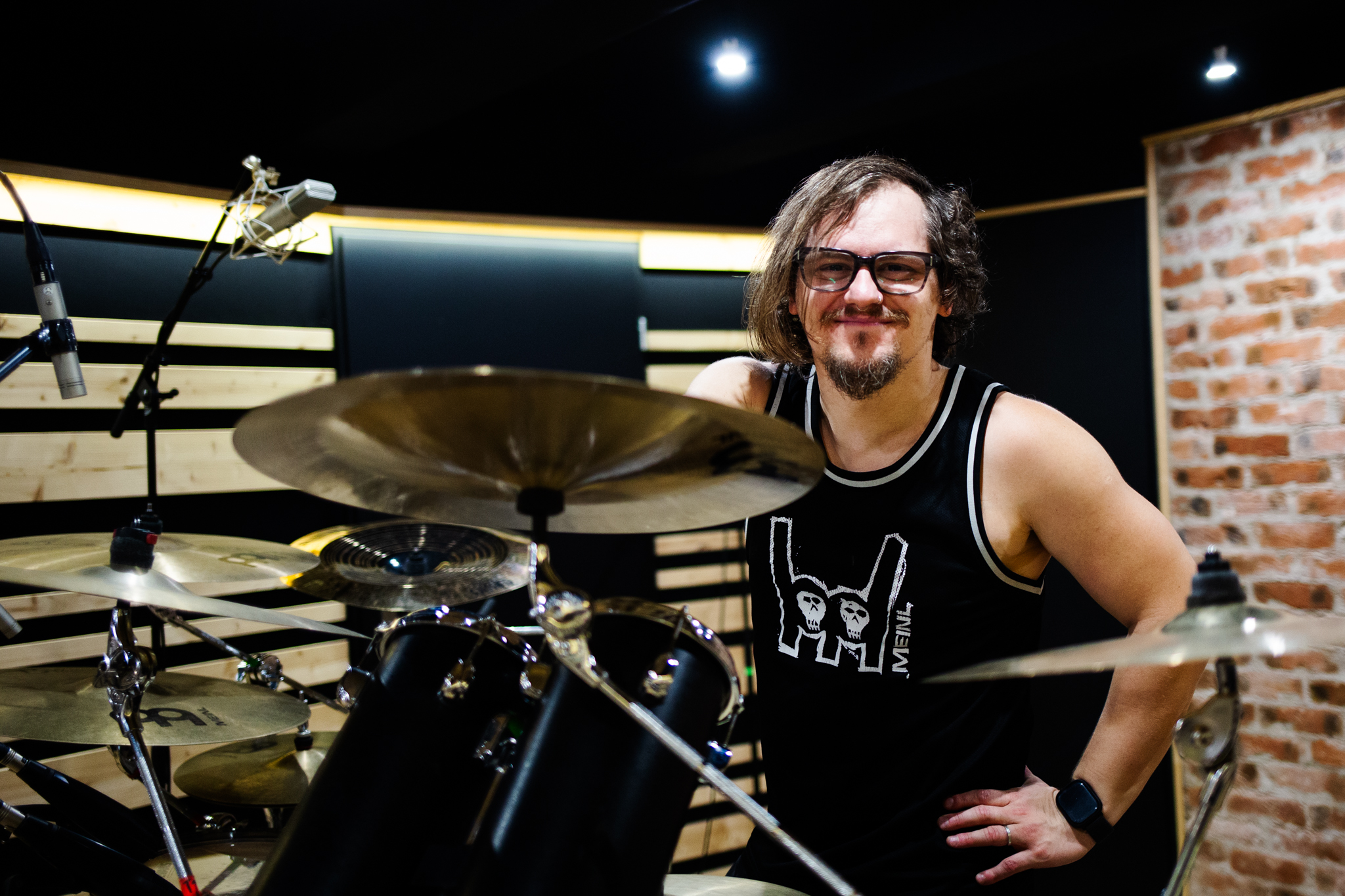
1., It's no secret that you've been choosing Grenma Studio for a while now whenever it's time to record drums for one of your bands. What's the reason for that?
Matyi Botlik has been Leander Kills' permanent live sound engineer for eight years now, so he's played a major role in shaping the band's own sound. Probably nobody understands better than him how my drums should sound, and on top of that he knows my strengths and weaknesses well, so we work together really smoothly.
I can say on behalf of the band as well that we fully trust his taste and technical skill. It's so much simpler to record when you don't have to spend ages explaining to each other what you want to hear — we pretty much already have the same thing in mind.
2., How did you feel during the session? How prepared did you arrive, and generally how much time do you spend preparing before an occasion like this?
Unfortunately, this was the first time I played these songs on drums in the studio at all, because the whole thing came together in a bit of a rush. I was still moving house the week before, then we figured we should quickly record the songs, since we're already shooting a music video for one of them the following week. It's a hectic period right now.
In general, though, I deliberately only prepare minimally for songs. I don't like memorizing the demo too much or working out the drum parts completely in advance, because I much prefer playing spontaneously.
What matters to me is the vibe and feeling that happens right there in the studio, in that moment. We'd rather record several takes, and sooner or later that moment arrives when everyone says, "okay, that's the one." We keep going until we get that.
3., Can you give us a bit of insight into exactly what you're working on? What will happen to the material you've just recorded, and who will be working on it going forward?
We're recording drums for Leander Kills' new album. So far, in this first round, four songs have been finished, and one of them is already coming out in October.
Matyi Botlik is in charge of the studio and the drum recordings, while Bence Barkóczi, Leander Kills' guitarist, handles the production and mixing. So basically the whole material is being made in-house, by people who know the band's sound extremely well and are able to shape it in a new direction.
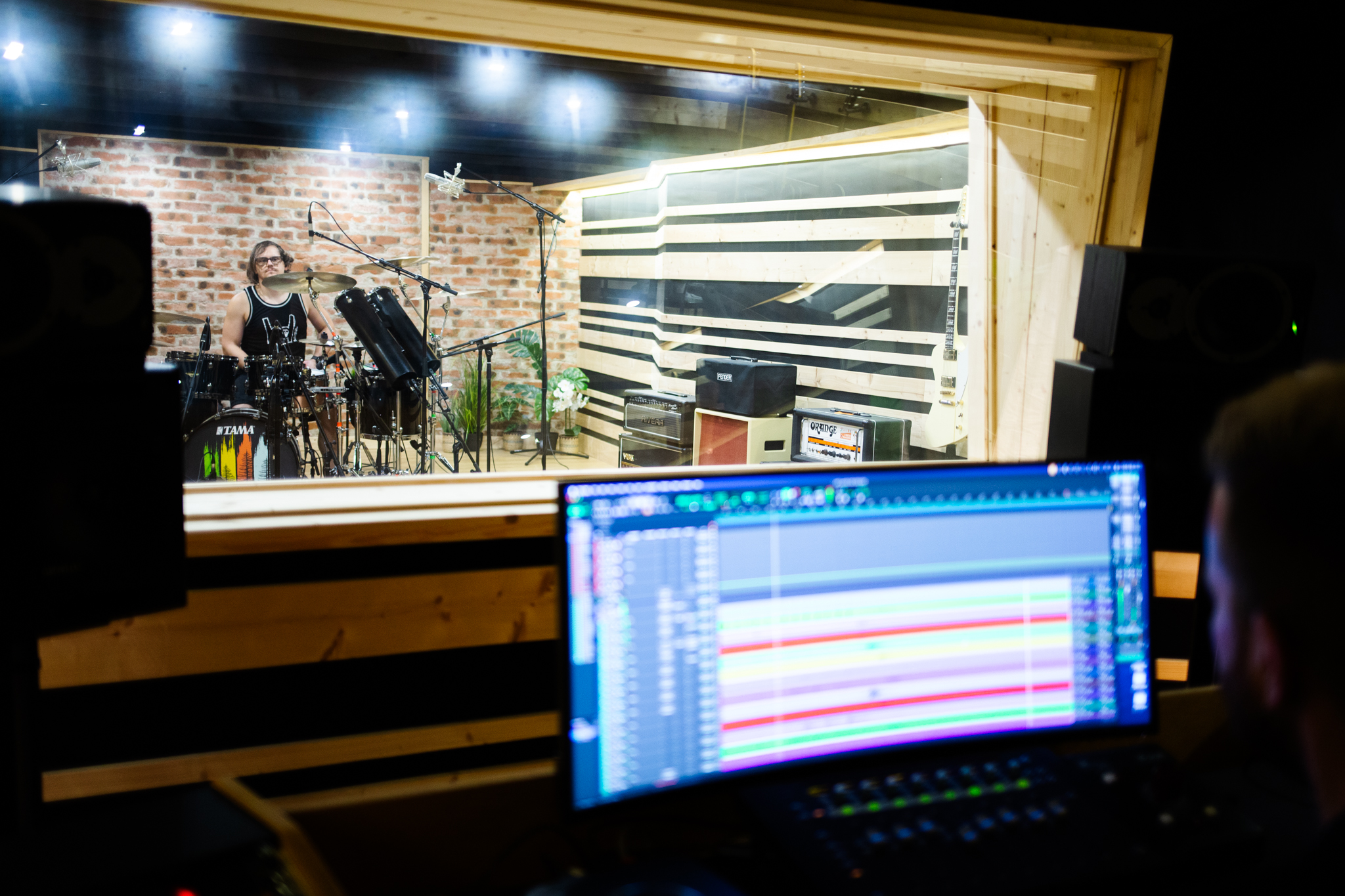
4., Was there anything interesting or experimental during the recording? I see there are two Octobans set up in your kit as well. How often do you actually use these in your music?
We experimented quite a lot with the miking. We used a lot of room mics, and the concept is to give them a bigger role in the final drum sound than usual.
Maybe the most interesting experiment was miking the toms not just from above, but from underneath as well. While mixing, it's really interesting to experience how much extra information and valuable frequency range shows up this way. You can shape a much fuller, bigger tom sound out of it.
In terms of arrangement, I mainly use the Octobans to bring some kind of uniqueness into the music. It's not an easy job, because in music built on this kind of high-gain guitars, it's not simple to find room for their character in the mix.
That's exactly why I love them: whenever there's a part where they work, they immediately give the song some special flavor. I don't force them in at all costs, but when they make sense, I'm very happy to reach for them.
5., Last but not least, where does your endorsement career stand right now? If I'm not mistaken, you're an official endorser for Tama and Meinl. Could you tell us exactly what that involves, and how much of a long-term relationship an arrangement like this really is?
I've been in a relationship with Meinl for about ten years now. They don't just make cymbals — they also handle instrument distribution.
The relationship naturally started with a Meinl cymbal endorsement, and then about six years later we signed with Tama as well. In Europe, Tama actually falls under Meinl's distribution, so it's fairly common to see the Tama–Meinl pairing among European drummers.
Tama actually came up even at the very beginning of our relationship, but back then I was still endorsing instruments from two other Hungarian drum manufacturers, so it ended up happening later.
From time to time we find our way back to each other through various smaller or bigger campaigns and collaborations. I'm not really the kind of musician who actively "pushes" themselves hard on social media platforms.
I consider myself primarily a live drummer, in a genuinely active band. What's always mattered most to me is that the instruments are actually there with me on stage and in the studio, and that the relationship with the manufacturers works long-term. In that sense, both Tama and Meinl have turned into very stable, multi-year collaborations.